
Enhancing Service Reliability and Application Availability for Optimal Retail Operations
Scaling distributed locations is challenging, but automation streamlines network and application management for seamless operations.

Introduction
The solution we offer, leveraging Edge as a key enabler, has been fully tried and tested in a retail store setting and it is also adaptable to a wide range of industries. Edge computing is becoming a transformative force for organizations with massively distributed locations, providing the foundation for digital transformation across daily operations. This architecture is particularly valuable for quick-service restaurants (QSRs), pharmacies, restaurants, convenience stores, and other similar sub-verticals where distributed locations create unique challenges.
However, as companies with distributed locations attempt to scale and digitally transform, new challenges arise. The most critical challenges of managing distributed workloads stem from three factors: scale, heterogeneity, and dependencies. Edge environments are massively distributed, often involving hundreds of thousands of devices across hundreds of locations, making scalability a significant hurdle. Adding to this complexity is the heterogeneity of edge deployments, which involve a wide array of technologies and vendors, including hyperscalers, software providers, and ISVs, all contributing to different aspects of the Edge stack, making integration and management challenging. Finally, dependencies between workloads, networks, and infrastructure create further complexity, as Edge workloads are business critical and require real-time, adaptive network configurations to ensure business continuity and minimize disruptions.
To address these challenges, NearbyOne, a cloud-native and intent-driven orchestration platform is leveraged. NearbyOne is built to automate the network functions, edge applications, and underlying infrastructure that support those functions. Designed to be interoperable and vendor-agnostic, the platform is capable of managing diverse Edge environments efficiently. By automating and simplifying these operations, it allows organizations to deploy and manage applications and infrastructure at scale.
Challenges
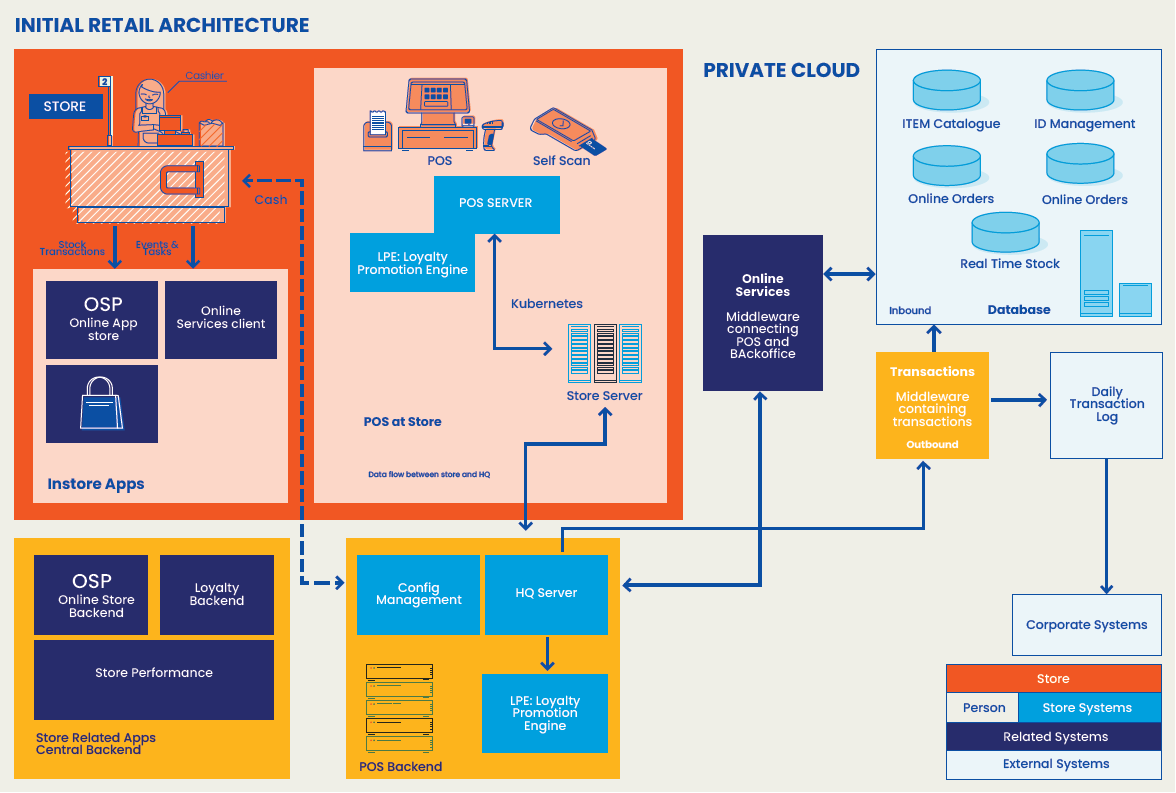
The RETAILER faced significant difficulties managing remote stores due to existing POS system’s reliance on cloud infrastructure. RETAILER’s current setup involves a backoffice server per site connected to the POS/SCO, with each site linked to the cloud for data synchronization, centralized management, backup and recovery, and integration to other enterprise back-office applications like ERP, SCM etc. However, this setup has exposed several critical challenges, primarily due to the reliance on cloud-based POS operations, creating a single point of failure.
- Single point of failureThe reliance on cloud-based POS operations made each store vulnerable to connectivity issues. Any disruption in the cloud link could stop POS functionality, leading to potential downtime and operational disruptions.
- Application lifecycle managementThe manual management of updates, patches, and upgrades for POS systems and other in-store applications was tedious and time-consuming. This challenge extended to managing drivers for POS-related hardware, such as scanners, printers, and self-checkout systems, adding complexity to maintaining the system’s overall functionality and reliability.
- Hardware and software failuresManaging site-specific hardware and software failures proved difficult without incurring significant downtime. The existing architecture, with a back-office server per site linked to the cloud, lacked local redundancy, worsening the problem.
- Operational and troubleshooting inefficienciesThe lack of remote troubleshooting capabilities meant that resolving technical issues required frequent onsite visits from the central team. This led to excessive travel, increased overtime, and severely delayed issue resolution. These inefficiencies crippled store operations during downtime, drastically reducing productivity and inflating operational costs.
- Connectivity issuesRegular site-level connectivity cuts created frequent potential downtime. These disruptions not only stopped store operations but also complicated troubleshooting efforts.
Initial retail architecture
Solution
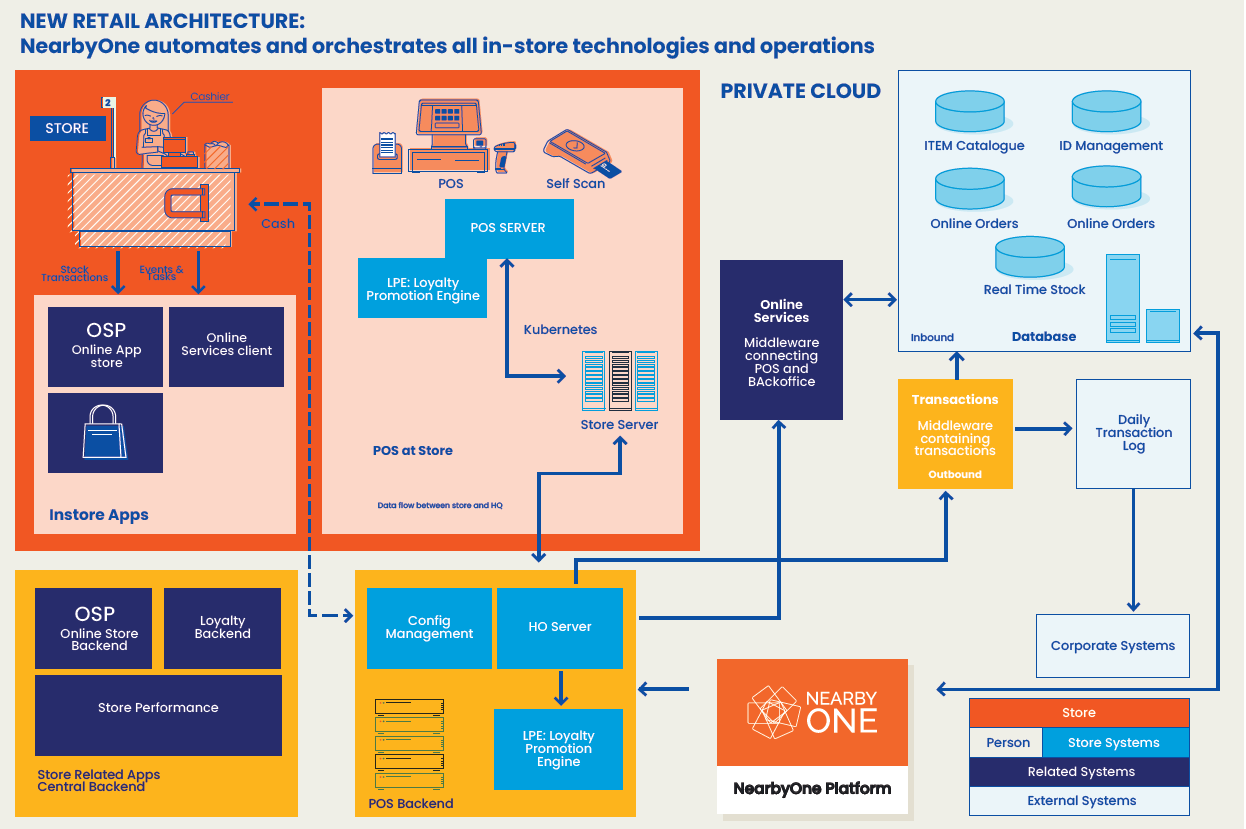
To address the challenges, Nearby Computing proposed decentralizing POS operations by containerizing (the virtualized) POS to run at the store level. This will provide local redundancy and be orchestrated from a central location, ensuring continuous operations even during hardware or connectivity failures.
This new architecture will enhance central observability and management, enabling quicker identification and resolution of issues.
- Decentralized POS operationsThe solution involves containerizing the POS to run locally at each store. This decentralization provides redundancy at the store level, ensuring that local operations can continue seamlessly even if there is a hardware or connectivity failure.
- Central orchestrationDespite decentralizing POS operations, a central orchestration system will manage these distributed systems. This central management will enable RETAILER’s IT team to monitor and control all store operations from a single location, improving efficiency and response times.
- Centralized hardware driver-stack for easy deploymentTo streamline the management of hardware components such as POS systems, scanners, and printers, Nearby Computing developed an easily deployable driver stack. This simplifies the deployment and lifecycle management of hardware drivers across all retail stores, enabling quick and consistent hardware setup at new store locations and smooth operations at existing stores.
- Application lifecycle managementA key improvement will be the automation of application updates, patches, and upgrades, which are currently handled manually. The new solution will provide centralized lifecycle management for all applications, including POS systems and associated hardware drivers for scanners, printers, and self-checkout systems.
- Security and compliance automationThe solution incorporates automated security updates and compliance checks across all POS systems and connected devices. This ensures that each store meets the data sovereignty regulations and maintains a high level of data protection, minimizing the risk of security breaches or compliance violations.
- Enhanced observability and managementThe new architecture will provide comprehensive visibility into the performance and health of all store systems. Centralized observability tools will enable the IT team to detect and address issues proactively, reducing the need for onsite visits and accelerating problem resolution.
- Kubernetes cluster deploymentEach store will deploy a Kubernetes cluster, virtualizing the POS across the cluster to ensure redundancy. This setup also allows other applications to run as containers, facilitating scalability and flexibility.
- Scalability and futureproofingThe containerized infrastructure is highly scalable, allowing RETAILER to add new nodes or clusters as needed. This flexibility supports the integration of new applications and services, ensuring the infrastructure can adapt to future technological advancements and growing demands.
- Improved customer experienceBy deploying new edge applications, RETAILER aims to enhance the in-store customer experience. Potential use cases include contactless checkout, real-time promotions, digital signage, flow analysis, inventory and fraud management, and Edge AI powered by in-house and third-party AI apps.
- Comprehensive orchestrationThe solution will offer 360-degree visibility, control, and lifecycle management through a single pane of glass for managing the comprehensive workload across infrastructure, applications, and connectivity fabrics.
New retail architecture
Benefits
By leveraging containerization both at the store level and centrally at the Head Office (HO), RETAILER can significantly enhance daily operations and pave the way for the retail store of the future. The benefits include improved management, streamlined operations, scalable infrastructure, and advanced failover capabilities, all contributing to a more resilient and efficient retail ecosystem.
- Enhanced resilienceLocal redundancy provided by the containerized POS operations at each store minimizes the impact of hardware or connectivity failures, ensuring continuous operation and reducing the risk of store downtime.
- Failover capabilitiesIn the event of a POS failure on-site, the system can automatically establish failover to other on-site or cloud resources, ensuring store operations continue without disruption. This safeguards revenue by preventing prolonged downtime and operational losses.
- Ease of managementCentralized management at the Head Office provides a unified view of the entire ecosystem, enabling faster identification of issues and immediate response, significantly improving operational efficiency across all stores.
- Application lifecycle managementAutomating application updates, patches, and upgrades for all stores ensures that systems remain secure, up-to-date, and free of vulnerabilities. This extends to managing software and drivers for POS-related hardware such as scanners and self-checkout systems.
- Streamlined operationsCentralized access to logs, telemetry, and diagnostics from all stores allows the IT team to efficiently troubleshoot and resolve issues, optimizing resource allocation and reducing the need for manual intervention.
- ScalabilityThe flexible containerized architecture allows for easy expansion, enabling rapid deployment and upgrading of new and existing stores through automated policies. This accelerates growth and reduces the need for extensive human and technical resources.
- Future readinessThe new orchestration platform equips RETAILER with the ability to deploy new applications, including custom AI and ML models, seamlessly. This future-proof approach ensures RETAILER can rapidly integrate innovative technologies and adapt to new business demands without overhauling the infrastructure.
- Value-added solutionsThe containerized infrastructure supports the integration of advanced solutions, such as video analytics for security, theft prevention, and customer retention, which can be easily deployed across stores to improve operations and enhance overall customer experience.
- Improved customer experienceThe deployment of advanced edge applications, such as contactless checkout, real-time promotions, and digital signage, elevates the in-store experience, increasing customer satisfaction and driving engagement.
- Cost efficiencyOptimized IT resources and reduced need for onsite interventions lead to lower operational costs, creating significant savings across the enterprise and allowing for more strategic use of budget and resources.
Quantifiable and measurable results
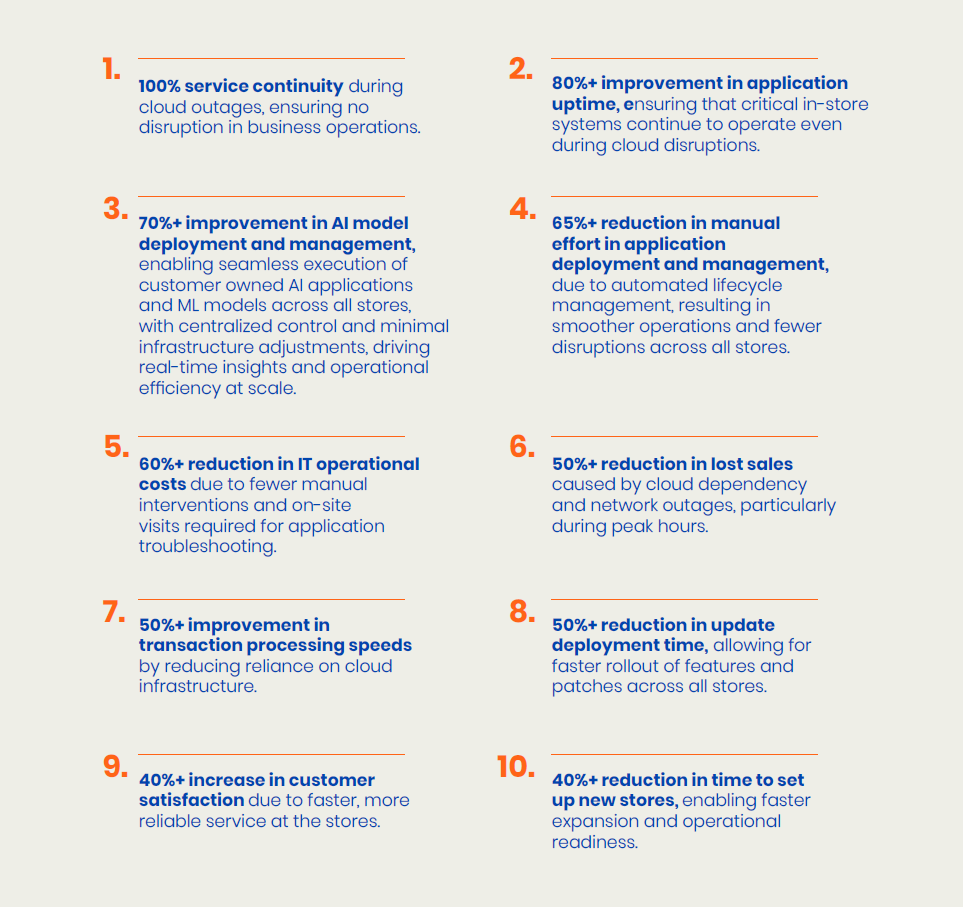
Implementing this solution has led to significant improvements in performance, efficiency, and cost savings. Below are some of the key measurable results achieved: