
Connecting the Grid: How 5G Enhances Electrical Substation Operations
Implementing 5G in electrical substation operations is complex and requires specific tools to manage and automate the various infrastructures, network functions and applications.
In partnership with Druid Software
Challenges
Electric substations play a crucial role in the power distribution infrastructure. Energy suppliers operate across various fields and locations, frequently managing assets in remote areas lacking onsite personnel. Improved security and monitoring at the edge are critical in the energy and utilities sector for multiple reasons, including facilitating real-time monitoring, reduced latency, and better security measures. However, they face several challenges that can impact their efficiency and reliability.
To address these challenges and implement a 5G network in electrical substation operations, energy suppliers could leverage edge computing technologies that enhance real-time surveillance, reduce latency, and improve security. These advancements are critical for maintaining the reliability and efficiency of energy management systems.
- Coverage and connectivityDue to geographical distribution, often in remote areas, electric substations face the challenge of maintaining robust connectivity. This is essential for facilitating communication and real-time data transmission across the power distribution infrastructure, which is critical for monitoring and control of the electrical grid.
- Operational inefficiency and ageing infrastructureTraditional electric substations are often hampered by outdated copper-based control systems that are prone to failures and increase maintenance costs. Outdated infrastructure also poses challenges in monitoring the health and safety of equipment. Typically, grid operators must conduct physical inspections to identify and resolve issues.
- Central visibility and managementDue to the remote and dispersed nature of substations, it is difficult for providers to have a centralised view and control over operations on a per-site basis. This may lead to a lack of real-time data, inconsistent operations, poor visibility of complex asset management and resource-intensive operations.
- Privacy and securityThe increasing connectivity of substations exposes them to cyber threats that can disrupt operations. Data privacy is crucial for security, compliance, and efficient collaboration among substations within a network. As substations are interconnected within a larger network, central management becomes necessary to maintain visibility and control.
- ScalabilityCloud-based solutions may face scalability limitations when dealing with thousands of distributed electric substations.
- Operational costsTransmitting large amounts of data to the cloud can be costly in terms of bandwidth and resources. Additionally, the cloud is not always the best option for applications requiring low latency.
- Response timeDecisions in substations must be made quickly to prevent failures or interruptions in the power supply. Latency in data transmission negatively affects swift decisions on operational management; lack of real-time data increases response time, which impacts the reliability of the grid and creates potential safety hazards.
The joint solution
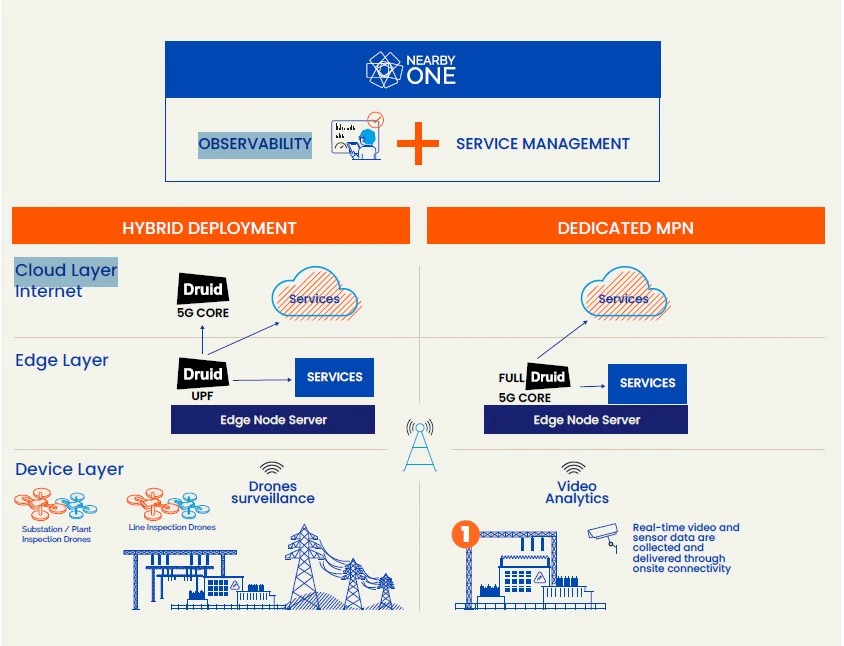
The implementation of a 5G Private Network (5G PN) in electrical substation operations is complex and requires specific tools to manage and automate the various infrastructures, network functions and applications. To make a viable solution, a robust and easy-to-use private cloud-native core is paired with a flexible and scalable solution that can orchestrate everything from a single site all the way to a widely distributed network, preferably from a single interface.
This document illustrates how to implement a 5G PN in an electrical substation and enable the following use cases: video analytics and drone inspection with Raemis™, Druid Software’s 5G core, and NearbyOne’s automation platform.
Druid’s Raemis™ 5G core network platform
Raemis™ is a set of cellular software assets optimised for business critical use cases. The platform harnesses 5G, 4G, 3G, 2G and Wifi radios from any vendor to implement standalone cellular core network solutions. It also integrates with mobile network operators using standard interfaces giving access to all of the radio resources of these operators. The Raemis™ platform adheres to 3GPP standards and stands out for its flexibility, slicing capabilities, interoperability, and simplified deployment and testing options, making it a compelling choice for private network deployments. Druid’s technology enables organisations to deploy private networks on-premises, in the cloud, or at the edge with enhanced connectivity, robust security, exceptional reliability and cost-efficiency.
The automation platform, NearbyOne
NearbyOne will deploy Druid’s core in different environments, from any hyperscaler infrastructure to private clouds and on-premises, ensuring a fully streamlined Day-0 deployment and automated lifecycle management, saving up to 90% of operation time and minimising operation costs. In addition, NearbyOne orchestrates Druid’s core slicing allowing multiple network slices to be created on top of a common physical infrastructure. Each slice can be allocated based on the specific needs of the applications, use case, or customer. Furthermore, thanks to the automation, services on the MPN can be exposed, or not, to specific slices automatically. Finally, Druid’s core, UPF, and slices can all be managed from the same dashboard used to manage services and infrastructure, providing a single pane of glass to manage the entire MPN.
Value proposition
- The joint solution between Druid Software and NearbyOne offers the most complete, flexible, economic and reliable 5G private connectivity, giving access to edge computing application management in minutes.
- By deploying Druid’s 5G Core with the NearbyOne orchestration platform, enterprises can significantly reduce costs through automation which helps to complete tasks in minutes, significantly reducing required resources. Druid’s streamlined Day-0 deployment and NearbyOne’s automated lifecycle management together result in up to a 90% reduction in operation time.
- Operators can also pivot to provide value-added services from all locations, leveraging the 5G private network to communities located around the distributed sites: fixed wireless access services (last mile solutions), integration of smart metering solutions, backhauling services for local authorities, and many other services, allowing operators to generate extra revenue from their existing infrastructure.
- Energy suppliers seeking private connectivity and services at their production sites will benefit from the most powerful and reliable yet compact Private 5G solution, deployed in minutes instead of weeks, and will gain immediate access to managed Edge Computing applications.
High-level solution architecture
Features description
NearbyOne
The solution can be deployed with Red Hat or any other Container Platform Management.
- Manage the infrastructure, the network functions, and service applications from a single pane of glass.
- Rich marketplace with a pre-existing catalogue of integrated applications and Druid’s solutions available out of the box.
- Service Applications intent driven orchestration, to automate overall solution deployment independently from the specific service applications KPIs and needs.
- Distributed telemetry, log, and tracing collection from multiple sites.
- Vendor agnostic and integrated support for hyperscalers, VMware vSphere and vCD, Red Hat Advanced Cluster Management for Kubernetes, SUSE Rancher, Sylva, Wind River Studio Cloud Platform and more.
- RBAC: unified RBAC framework delivers full multi-tenancy.
Druid’s Raemis™ 5G core network platform
- Intuitive Management Interface which makes installing and maintaining a private cellular network as easy as setting up Wifi. The Raemis™ GUI uses the Raemis™ RestAPI to access the core software and 3GPP components of the network, enabling an IT manager to perform complex tasks in a few clicks.
- REST API integration enables a myriad of value added applications to enhance the private cellular network.
- The Raemis™ platform supports and enhances the slicing concept directly to Enterprise and Edge Private Networks, with an intuitive web interface that can be operated by any qualified IT technician.
- The Raemis platform can scale up and down to a single eNodeB device and a handful of users, all in a single VM with a small computing and memory footprint.
- Raemis supports distributed architectures which can be deployed in cloud native environments with central management of multiple edge sites, benefiting from the Raemis™ MEC and redundancy capabilities.
Benefits
The convergence of 5G private networks and edge computing as enablers of video analytics and drone surveillance use cases transforms digital substations into intelligent, secure, and efficient hubs for managing our evolving energy landscape.
- Enhanced surveillance and securityVideo analytics processes live camera feeds, detecting anomalies, intrusions, or equipment malfunctions. 5G ensures low-latency communication, allowing real-time video analysis. Drones equipped with cameras provide visual surveillance, covering large areas efficiently.
- Predictive maintenanceEdge computing processes data from sensors and cameras within the substation. 5G facilitates rapid transmission of maintenance alerts. Drones perform visual inspections, identifying potential issues before they escalate.
- Emergency response and situational awarenessDuring emergencies, video analytics can identify critical situations such as fires, leaks or unauthorized access. 5G enables real-time communication between drones, control centers, and field personnel. Drones equipped with thermal cameras and LIDAR provide situational awareness.
- Reduced downtime and improved efficiencyVideo analytics helps identify failing components early, reducing downtime. 5G private networks ensure seamless communication for remote diagnostics and maintenance, as well as central visibility. Drones perform routine inspections, optimizing asset management.
- Scalability and flexibilityEdge computing allows for flexible deployment of video analytics applications. 5G networks can scale to accommodate additional devices and surveillance cameras.
- Integration with smart gridsDigital substations, powered by 5G and edge computing, seamlessly integrate renewable energy sources. Drones monitor solar panels, wind turbines, and other distributed energy resources.
- Single pane-of-glass managementView the entire operation via a single dashboard, with the ability to manage all operations centrally and at a granular level. Manage all operations per site, combining infrastructure, communications via 5G private networks and the applications required per substation.