

Transforming Port Operations with Autonomous Solutions
A joint solution deploying drones via a private 5G network to enhance port security operations.
In partnership with Unmanned Life

In today’s rapidly evolving digital landscape, the security of critical infrastructures such as ports has become more crucial than ever. However, the complexity and volume of operations in these hubs present significant challenges, including congestion, delays, and inefficiencies, which directly impact global trade. Traditional methods of managing port operations have struggled to keep pace with the growing demands for speed, accuracy, and efficiency. Furthermore, the environmental impact and sustainability of port operations have come under scrutiny, pressing the need for innovative solutions to optimize logistics, reduce carbon footprints, and enhance operational transparency.
With the rise of autonomous technologies, there is a growing opportunity to enhance security measures through innovative solutions that leverage the power of autonomy, artificial intelligence, and edge computing. At the forefront of this technological revolution are companies like Nearby Computing and Unmanned Life, whose collaboration is poised to redefine autonomous security solutions for ports. Unmanned Life specialises in autonomous drone orchestration, while Nearby Computing offers an innovative edge-to-cloud automation and orchestration platform, NearbyOne.
- With this collaboration, customers can expect a seamless and efficient security solution that not only addresses the complexities of port security but also delivers tangible benefits such as real-time monitoring, threat detection, and incident response.
- The Nearby Computing solution automates and manages the infrastructure, network, and application complexities, allowing Unmanned Life to focus on the critical payload and mission management of the deployed drones.
- By focusing on managing complexity while maximizing the benefits of autonomous drone applications, Unmanned Life and Nearby Computing are paving the way for safer and more secure port operations.
Challenges
- Asset management and trackingPorts manage a diverse range of assets, including ships, containers, vehicles, and equipment. Effective tracking and management of these assets are essential for optimising port operations, ensuring efficient movement, and minimising delays. Technologies such as RFID and GPS can enable real-time monitoring and enhance asset visibility.
- Interoperability and standardisationPorts involve a complex ecosystem with various stakeholders, including shipping companies, logistics providers, and regulatory bodies. The lack of standardisation across different systems and technologies can hinder the seamless integration of edge computing and automated devices.
- Infrastructure maintenance and reliabilityPorts rely on a complex infrastructure comprising terminals, berths, cranes, and other equipment. Aging infrastructure can lead to increased maintenance needs, equipment failures, and potential disruptions. Regular maintenance and modernization efforts are essential to ensure reliability.
- Scalability and flexibilityPorts must be able to scale their operations efficiently to handle varying volumes of cargo without compromising on efficiency or security. Traditional IT infrastructure may not offer the required scalability or flexibility to support dynamic operations.
- Data security and privacyImplementing edge computing solutions involves processing and storing sensitive data at the edge of the network, which can pose significant security and privacy risks. The increased attack surface and the potential vulnerability of devices to cyber threats need to be meticulously managed.
- Real-time data processing and analysisThe effectiveness of automated robots and drones relies heavily on real-time data processing and decision-making capabilities. Delays or inaccuracies in data analysis can lead to operational inefficiencies or safety risks.
Joint value proposition: seamless security solutions
The collaborative efforts between Unmanned Life and Nearby Computing signify a strategic alliance aimed at revolutionising port security through a comprehensive autonomous drone solution. This joint solution is designed to reduce the complexities that result from combining networks such as 5G, infrastructure such as public and private clouds, and applications such as drone management, providing operators with a streamlined and effective security system.
Focused on simplifying complexity, Nearby Computing assumes responsibility for network management, ensuring robust connectivity, scalability, and high availability. Meanwhile, Unmanned Life remains committed to delivering tangible benefits through autonomous drone applications, including security, situational awareness, emergency response and inspections.
Functionality delivered to customers
Unmanned Life
- Autonomous fleet orchestrationSeamless coordination and management of multiple drones within a fleet. Through advanced algorithms and intelligent autonomy, the system optimises fleet deployment, routing, and task allocation, maximizing efficiency and coverage for enhanced security operations.
- Mission control capabilitiesSeamless planning, execution, and monitoring of drone missions from a centralised command centre. Intuitive interfaces and advanced planning tools let customers define flight paths, set mission parameters, and analyse real-time data streams for informed decision-making.
- Data managementCollect, store, and analyse data gathered by the drones. Organizing and categorizing data streams, performing analytics, and generating actionable insights support data-driven decision-making and optimization of security strategies.
- Artificial intelligence capabilitiesAI algorithms enable drones to adapt to changing environments, identify patterns, and make autonomous decisions in real-time, enhancing situational awareness, responsiveness, and overall effectiveness in addressing security challenges.
- Thermal camera and night visionDetection and monitoring of intruders and security threats even in low light or adverse weather conditions. Thermal and visual data are analysed to identify anomalies and potential security breaches.
Nearby Computing
- Multi-cloud, multi-site platform with centralized control dashboardPort operators can effortlessly manage all sites through a unified interface, overseeing infrastructure, applications, and connectivity with unparalleled ease.
- Intent-based orchestration engineFacilitates the management of multi-cloud deployments, infrastructure resources, and virtualized functions (xNFs), ensuring seamless operation across diverse environments.
- Advanced lifecycle managementRollout and rollback of software versions, automatic or manual updates, and maintenance of software and hardware, streamlining the deployment and maintenance of critical systems.
- Observability stack as a serviceA full observability stack powered by standard open-source components such as Prometheus, Grafana, Elasticsearch, and Kibana, providing real-time insights into system performance.
- Cloud-hosted or on-premiseThe NearbyOne framework runs on top of Kubernetes deployed as a Helm chart (on-prem K8s, ROSA, ARO, GKE).
- Unified configuration managementConfigure multiple vendor applications via API or UI through a unified interface.
- RBAC and high availability supportThe RBAC framework ensures full multi-tenancy support, while HA mode and federation capabilities guarantee uninterrupted operation and fault tolerance even in the most demanding environments.
Use case example: private 5G fleet of drones
In this use case example, we explore a joint solution developed by Unmanned Life and Nearby Computing for deploying a fleet of drones through a private 5G network to enhance security operations in a port environment. This example showcases the collaborative efforts of both companies and the architecture of the joint solution, highlighting the contributions of Nearby Computing and Unmanned Life and the resulting benefits for port operators.
The joint solution developed by Unmanned Life and Nearby Computing comprises a comprehensive architecture tailored to the unique requirements of port security.
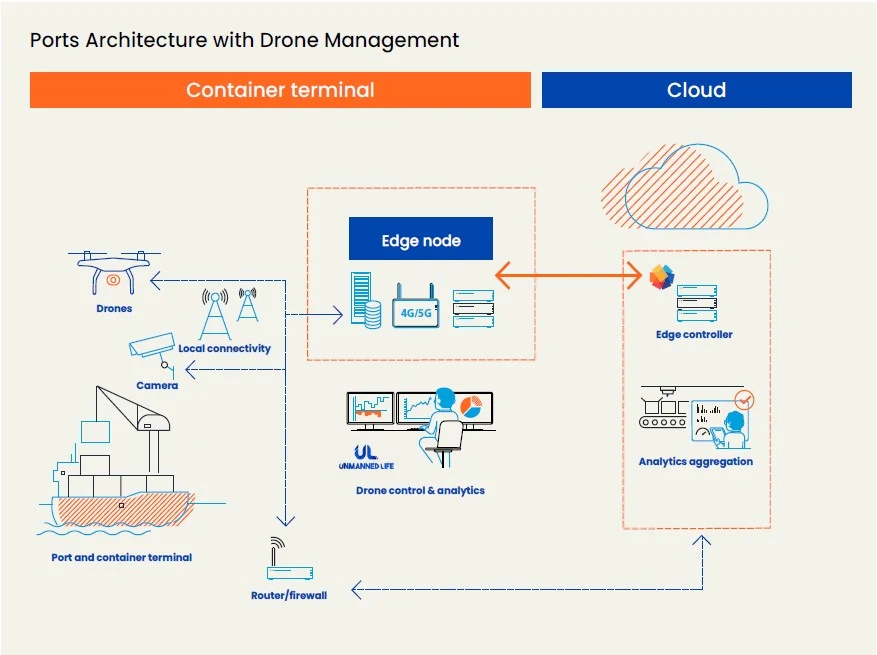
Nearby Computing contribution
Nearby Computing plays a crucial role in providing the underlying infrastructure and management capabilities necessary for the deployment of the fleet of drones over private 5G. This includes:
- Setting up the networking infrastructure to support 5G connectivity for the drones.
- Implementing a centralized control system for managing and monitoring the fleet of drones.
- Providing advanced analytics and reporting capabilities for assessing security threats and optimizing operations.
Unmanned Life contribution
Unmanned Life focuses on delivering the autonomous drone technology and applications that form the core of the solution. This includes:
- Developing the software algorithms for autonomous navigation, surveillance, and response.
- Integrating sensors and payloads onto the drones for collecting real-time data and imagery.
- Implementing mission planning and control software for orchestrating the actions of the drone fleet.
Conclusions
The collaboration between Unmanned Life and Nearby Computing represents a groundbreaking advancement in port security. By leveraging their combined expertise, innovative technologies, and customer-centric approach, they have developed a powerful solution that integrates autonomous drone technology with cutting-edge edge computing infrastructure.
The joint solution offers a unique value proposition to port operators by seamlessly integrating hardware, software, and networking components. It provides a comprehensive and efficient means of safeguarding port facilities and assets, automating surveillance, improving situational awareness, and enabling rapid response to security threats.
One of the key competitive advantages of this joint solution lies in its ability to scale efficiently, ensuring seamless deployment and management of autonomous drone operations across diverse port environments. Moreover, its resilience to disruptions and adaptability to evolving security requirements set it apart in the market, offering port operators a reliable and future-proof solution for their security needs.